Number 001
Crime Rave ’96
A turn-based crime strategy sim game on a hex map, set in spring 1996.
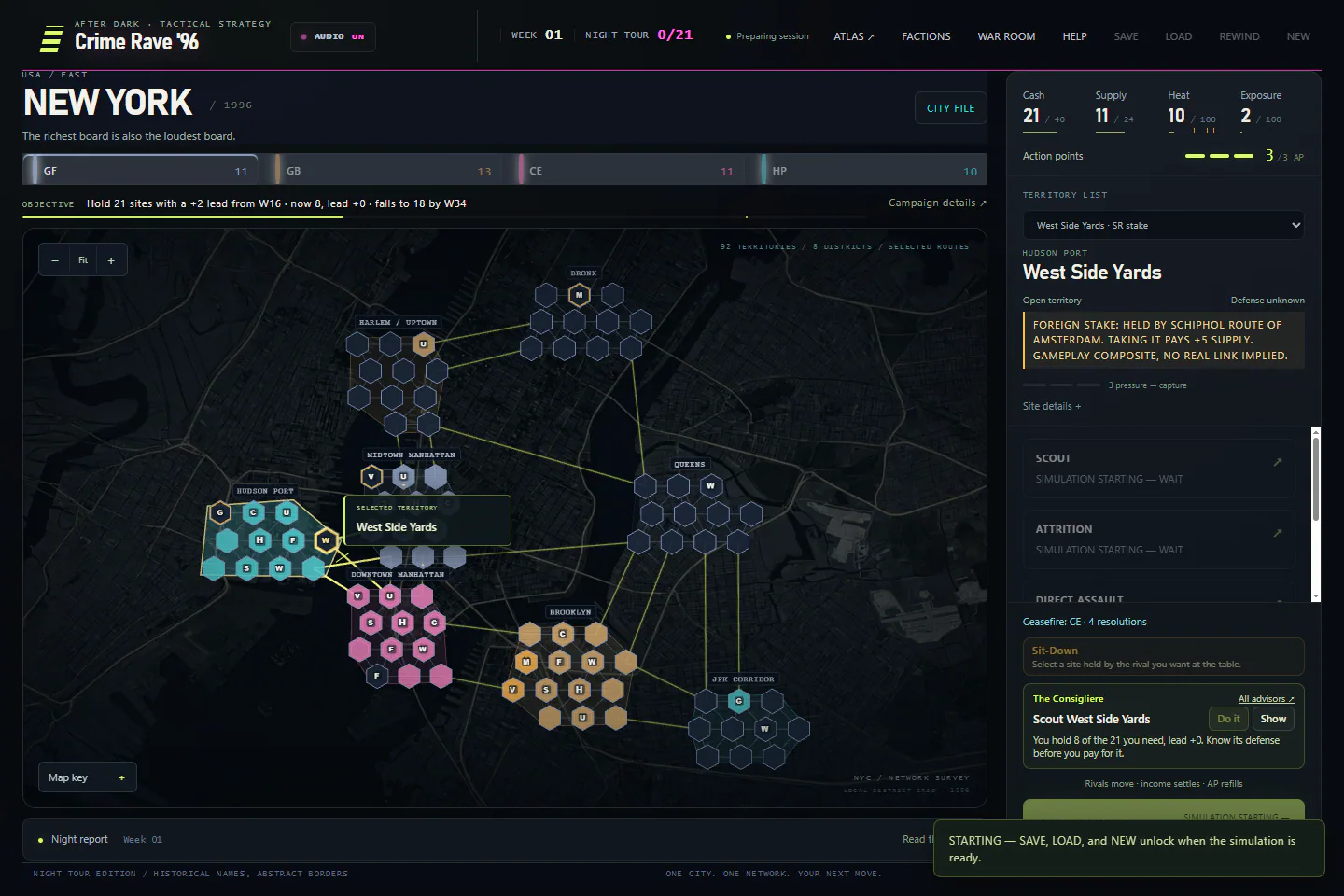
Take a city from its rival crime factions in spring 1996, one territory at a time. Each week you spend three action points on orders such as scouting, attacking and fortifying, then the rivals move, against you and against each other. Real nightclubs of the period are on the maps of many of its cities, and four advisors offer plays you can take or ignore.
Content note Mature themes: organized crime and the drug trade.
Opens in this tab. 6.9 MB to load.
About
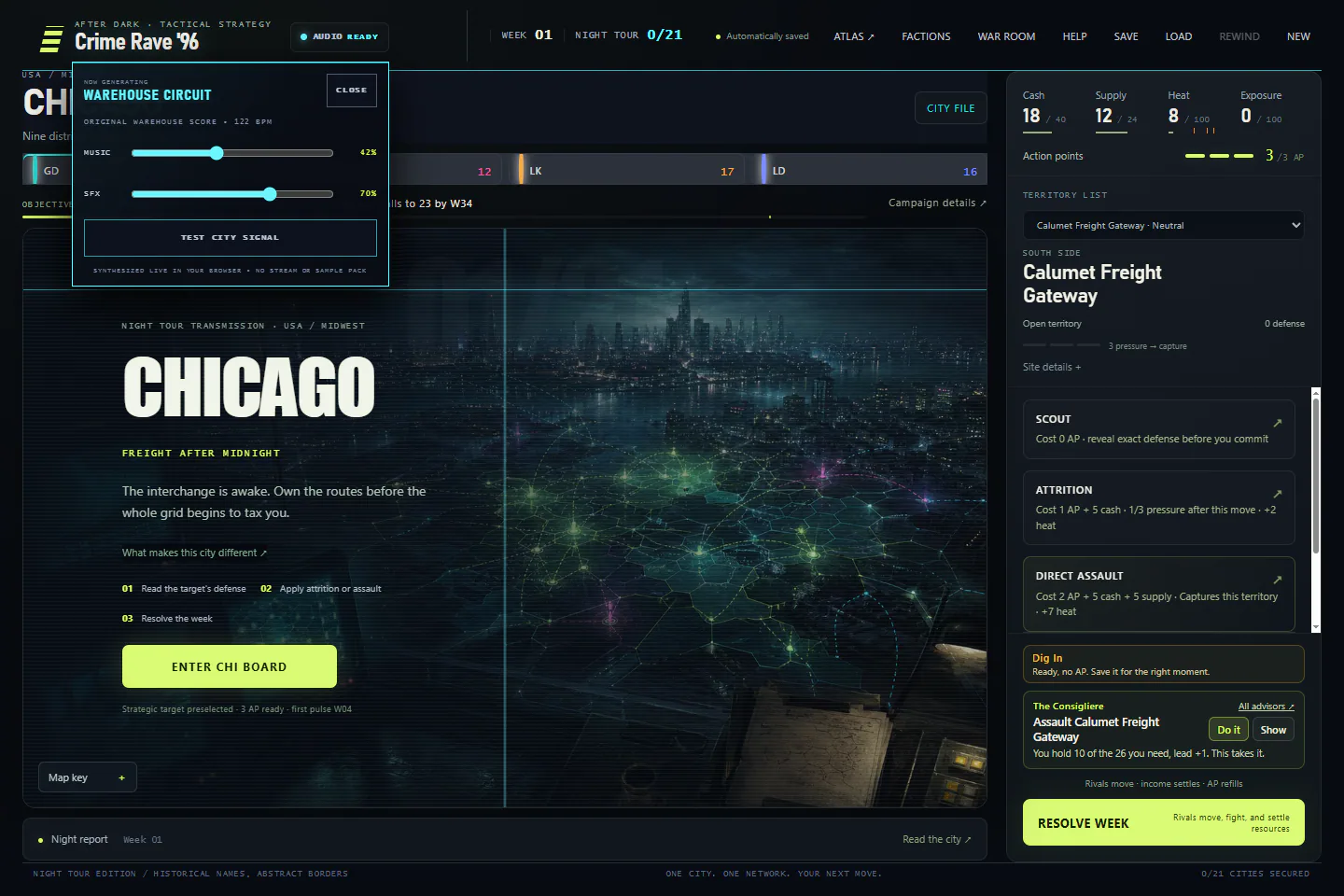
Crime Rave ’96 is a turn-based strategy game. Its cities run from Chicago and New York to Medellín, Amsterdam and the Golden Triangle, and in each one you play one of the local factions. Clubs matter: some factions run on nightlife money and hit club sites harder. Every city also has its own synthesized score, from warehouse and acid to dub and breakbeat.
The four advisors each read the board their own way: the Consigliere reads the win, the Captain holds your ground, the Bookkeeper watches money and heat, and the Wire reads the world. Each names one play, and Do It carries it out. On Kingpin rules they argue for different plays instead of agreeing on one.
The rivals follow written rules and chance; no AI model plays them. A few faction names are drawn from real groups of the period; most are composites invented for the game. Borders, strengths and who holds what are game abstractions, and a real venue on the map does not imply any criminal involvement.
Facts
| Cities | 21, each a separate campaign |
|---|---|
| Factions | 4 per city, 84 in all |
| Length | Up to 36 weeks per city |
| Advisors | Always, On call or None |
| Rules | Standard or Kingpin |
| Players | 1 |
Screenshots
Select one to see it full size
How it plays
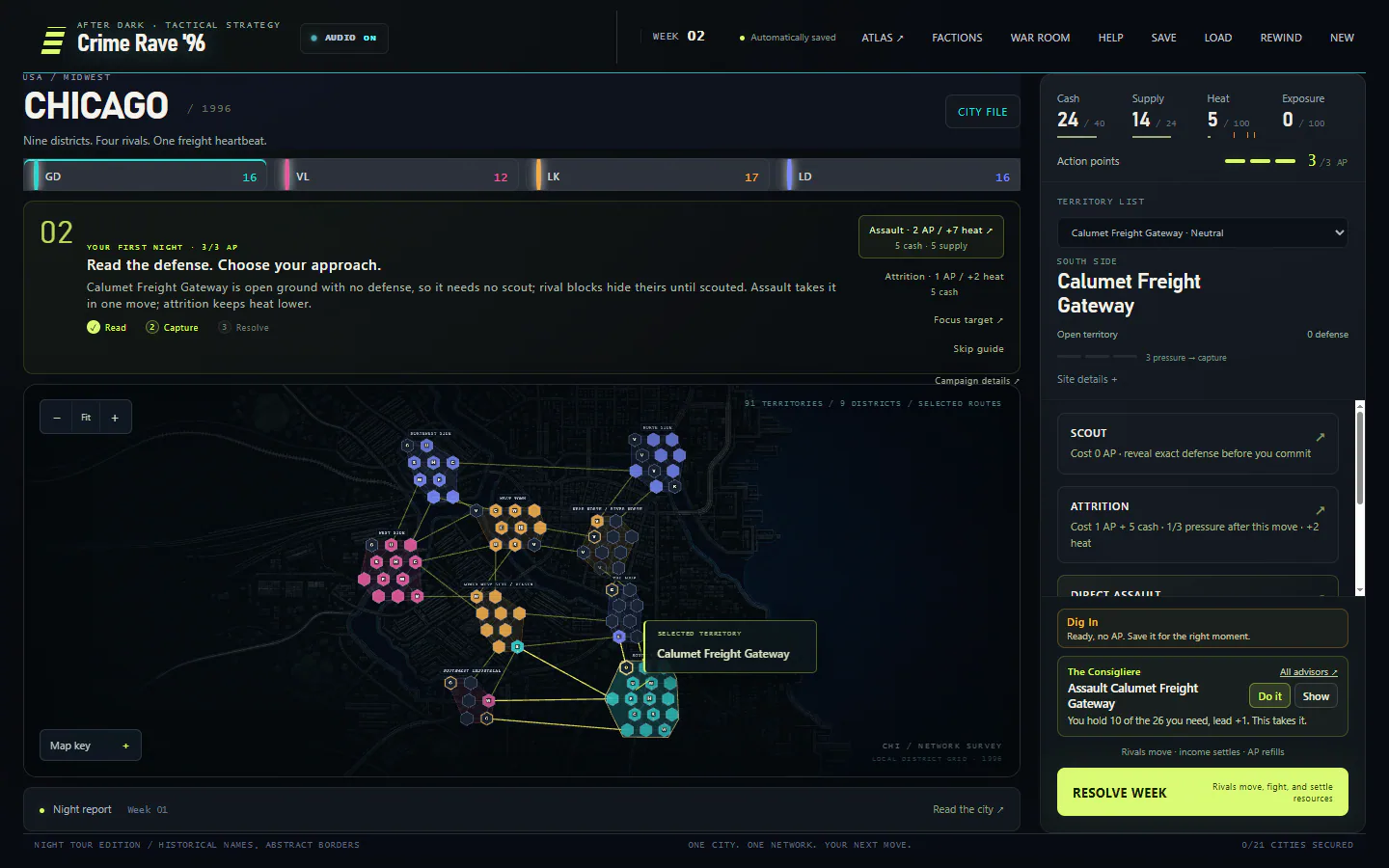
Each city is a board of hexagonal territories grouped into districts. You start in Chicago, where a short guide walks you through the first night with real orders: scout a reachable opening, take it, then resolve the week.
Rivals never move until you resolve the week. Each gets one order a week, two once the city goes to war in week 14, plus a signature play on a schedule shown on screen. Each rival is also at war with the other rival it borders most, so you can hit whoever is losing.
Orders
- Scout
- Reveals a territory’s defense before you spend on an attack.
- Attrition
- Adds 1 pressure. Three pressure captures a territory; defense absorbs pressure first.
- Direct Assault
- Adds 3 pressure at once, paid partly in supply.
- Infiltrate
- A chance to put pressure on a site you do not border.
- Fortify
- Adds defense to your own territory.
- Ceasefire
- Two weeks of peace with one rival. The price rises each time.
- Lay Low
- Spends cash and supply to cut your heat.
- Move Supply
- Turns surplus supply into cash, for a little heat.
- Buy Supply
- Turns cash into supply, for a little heat.
- Back the Locals
- Pays locals to hit a rival’s stake in another city. While that stake is under pressure the rival is stretched: it acts once a week and attacks on it land harder. Not during a ceasefire with that rival.
- Reinforce Abroad
- Clears the pressure on your own stake in another city and raises its defense to 4, so you are no longer stretched.
- Resolve Week
- Ends the turn.
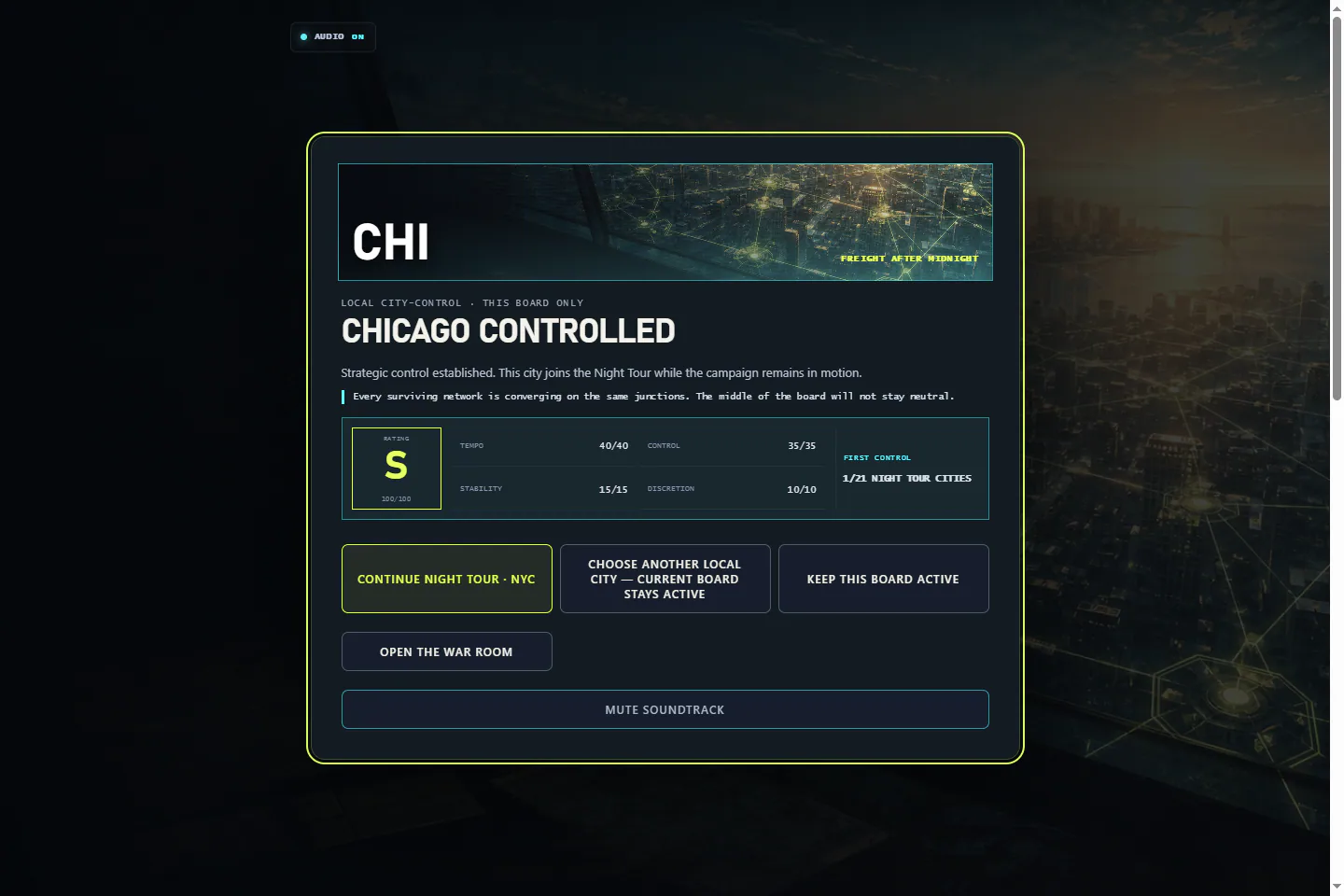
There is more than one way to take a city: hold about half of its strategic sites at any time (more for some factions); from week 16, hold your faction’s target with a two-site lead over the strongest rival; or stay four sites ahead of every rival for a set number of weeks. Help, in the top bar, gives the exact numbers for the city you are in.
Heat from 40 makes attacks cost more, and resolving a week at 60 or more lets a task force close your softest outer site. Arrest, death, losing your home network or running out of weeks ends that city’s campaign. After a defeat you can rewind to the start of the last planning week and try different orders.
Leaving a city parks it as a frozen snapshot; it resumes where you left it when you return. Kingpin rules raise the site target for most factions, and rivals hunt a leader harder.
How much you hear from the advisors is up to you, and you can change it at any time. On Always they speak every week. On call, nothing is shown until you spend a call on one advisor, whose read stays up until you resolve the week; you get 8 calls per city on Standard and 10 on Kingpin. None plays from the board alone. Once you have given your first order, the city’s debrief shows the most help you used.
Controls
| Select a territory | Click or tap a hex, or choose it from the territory list. |
|---|---|
| Move between connected territories | Arrow keys or W A S D while the map has focus. |
| Zoom and pan | The − and + buttons, Fit to reset; drag the map to pan. |
| Give an order | Choose it from the order list. Lay Low, Move Supply and Buy Supply appear above Resolve Week only when needed; Back the Locals and Reinforce Abroad are in the War Room. |
| Close a panel | Escape. |
| Save and load | Save and Load, in the top bar. The game also saves after every change and restores on reload. |
Notes
- Saves stay in this browser. Clearing the site data for sims.games deletes them, and they do not follow you to another browser or device.
Questions
Is Crime Rave ’96 free to play?
Yes. It is single-player and runs in the browser, with nothing to install.
How does a week work?
Each week you spend three action points on orders such as scouting, attacking and fortifying. Then the rivals move, against you and against each other. The rivals follow written rules and chance; no AI model plays them.
How many cities are there?
There are 21 cities, each a separate campaign of up to 36 weeks. Four factions play in each city, 84 in all. The cities run from Chicago and New York to Medellín, Amsterdam and the Golden Triangle.
What do the advisors do?
Four advisors, the Consigliere, the Captain, the Bookkeeper and the Wire, each read the board their own way and name one play; Do It carries it out. They can be set to Always, On call or None. On call, you get 8 calls per city on Standard rules and 10 on Kingpin.
Are the factions and clubs real?
A few faction names are drawn from real groups of the period; most are composites invented for the game. Real nightclubs of the period are on the maps of many of the cities, and a real venue on the map does not imply any criminal involvement.
What are the mature themes?
Organized crime and the drug trade.