Number 002
Red Line
A turn-based geopolitical & nuclear crisis strategy sim game.
Lead one country through a nuclear crisis, from Cuba in 1962 to the present day, and try to come out ahead without the world ending in nuclear war. Each turn your advisers propose a plan; you approve it or change it, and when two of them disagree, you choose between them.
Content note Mature themes: nuclear war between real countries, with estimated death tolls, and present-day wars. A fictional simulation built on public data: it names real officeholders, but the advisers’ lines are written for the game, not by any real person, and nothing in it is a forecast.
Opens in this tab. 4.6 MB to load.
About
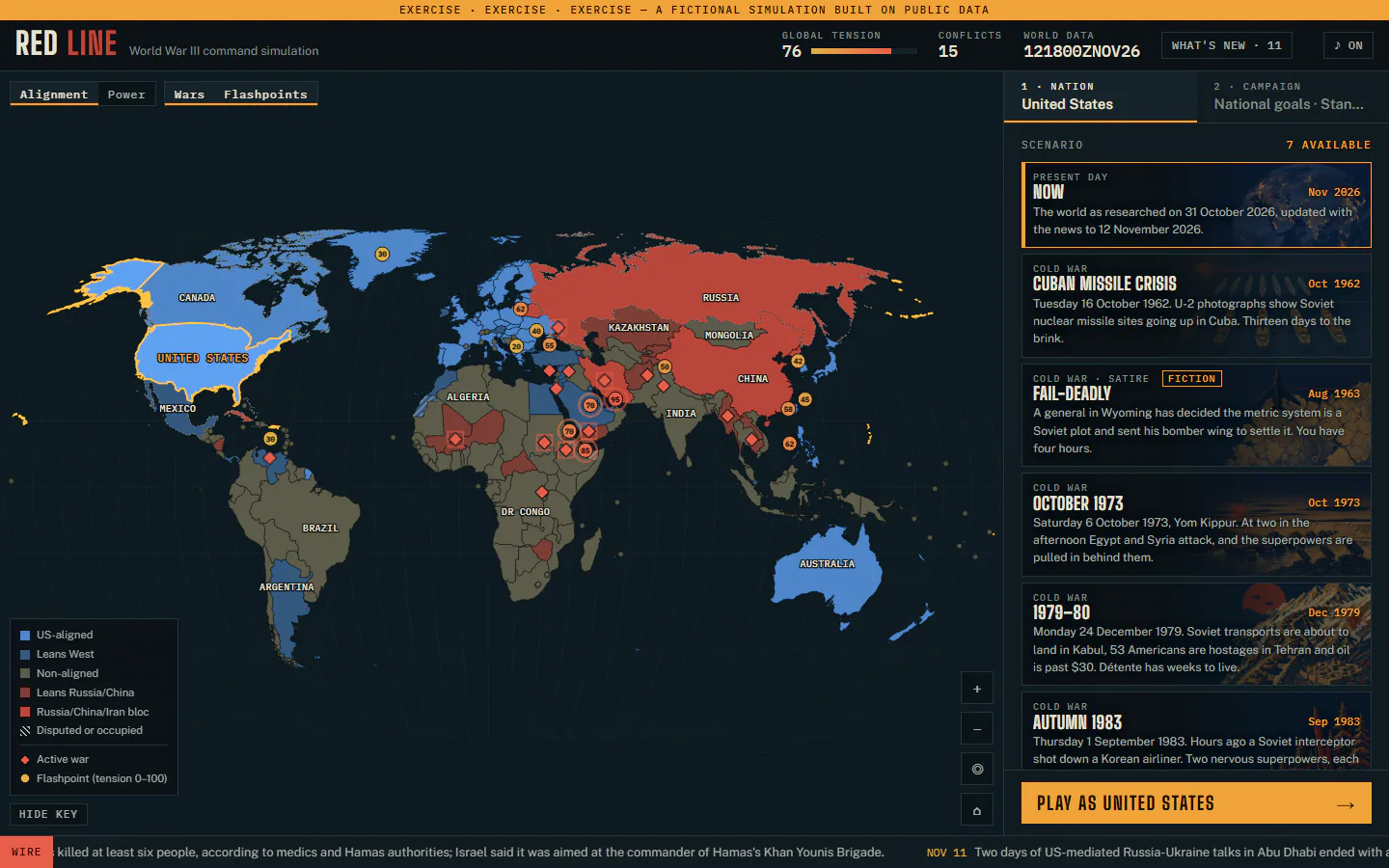
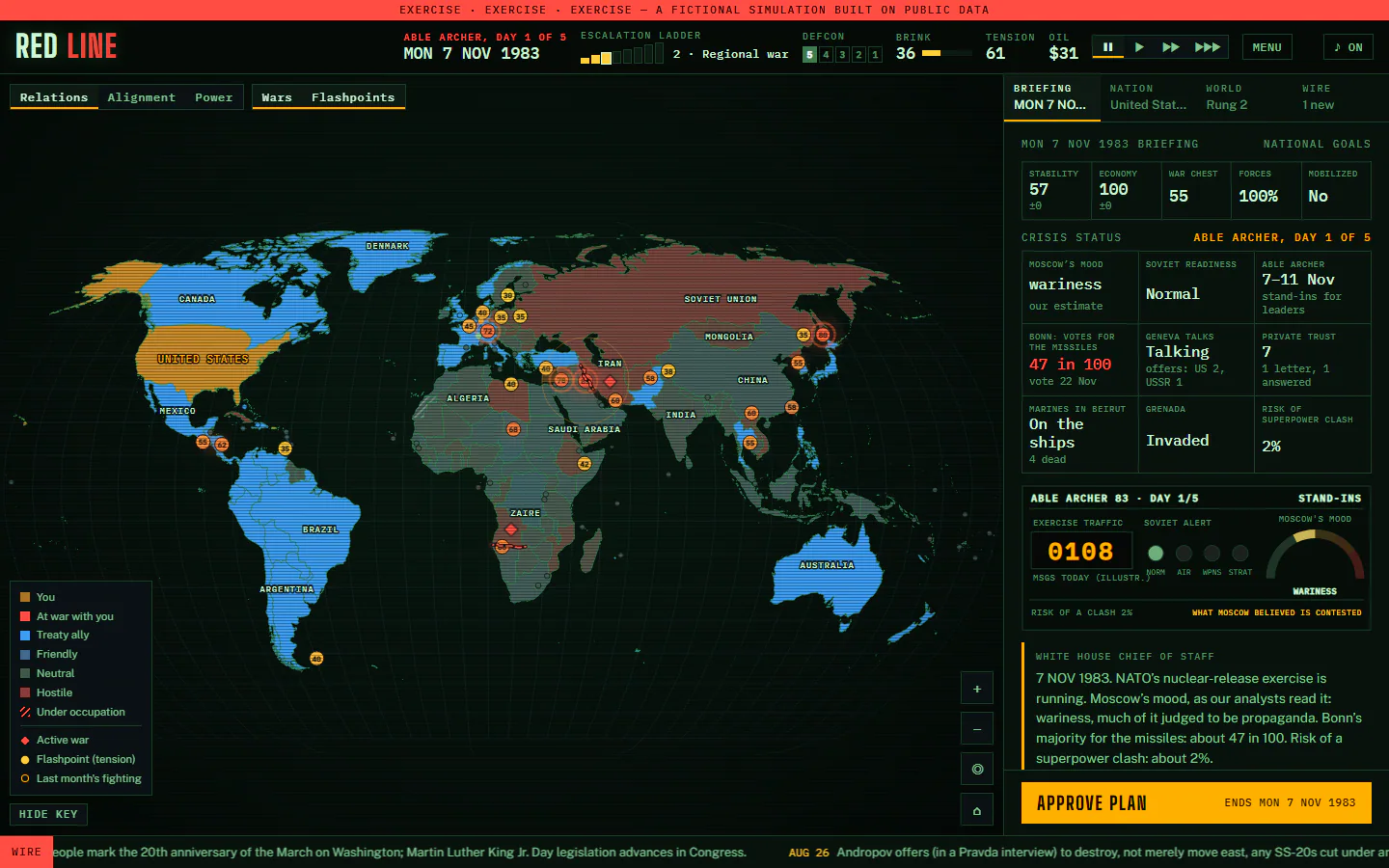
Red Line has seven scenarios. Four start from history: the Cuban Missile Crisis of October 1962; October 1973, when Egypt and Syria attack on Yom Kippur; 1979–80, with Soviet transports about to land in Kabul and Americans held hostage in Tehran; and autumn 1983, hours after a Soviet interceptor has shot down a Korean airliner. The present day is built from the real world and recent news. Two are satires with invented casts: Fail-Deadly, in which a general in Wyoming, sure that the metric system is a Soviet plot, sends his bomber wing to settle it in August 1963, and One Warhead Short, which opens in January 1995 just after a missile from a Russian base has come down on North Dakota.
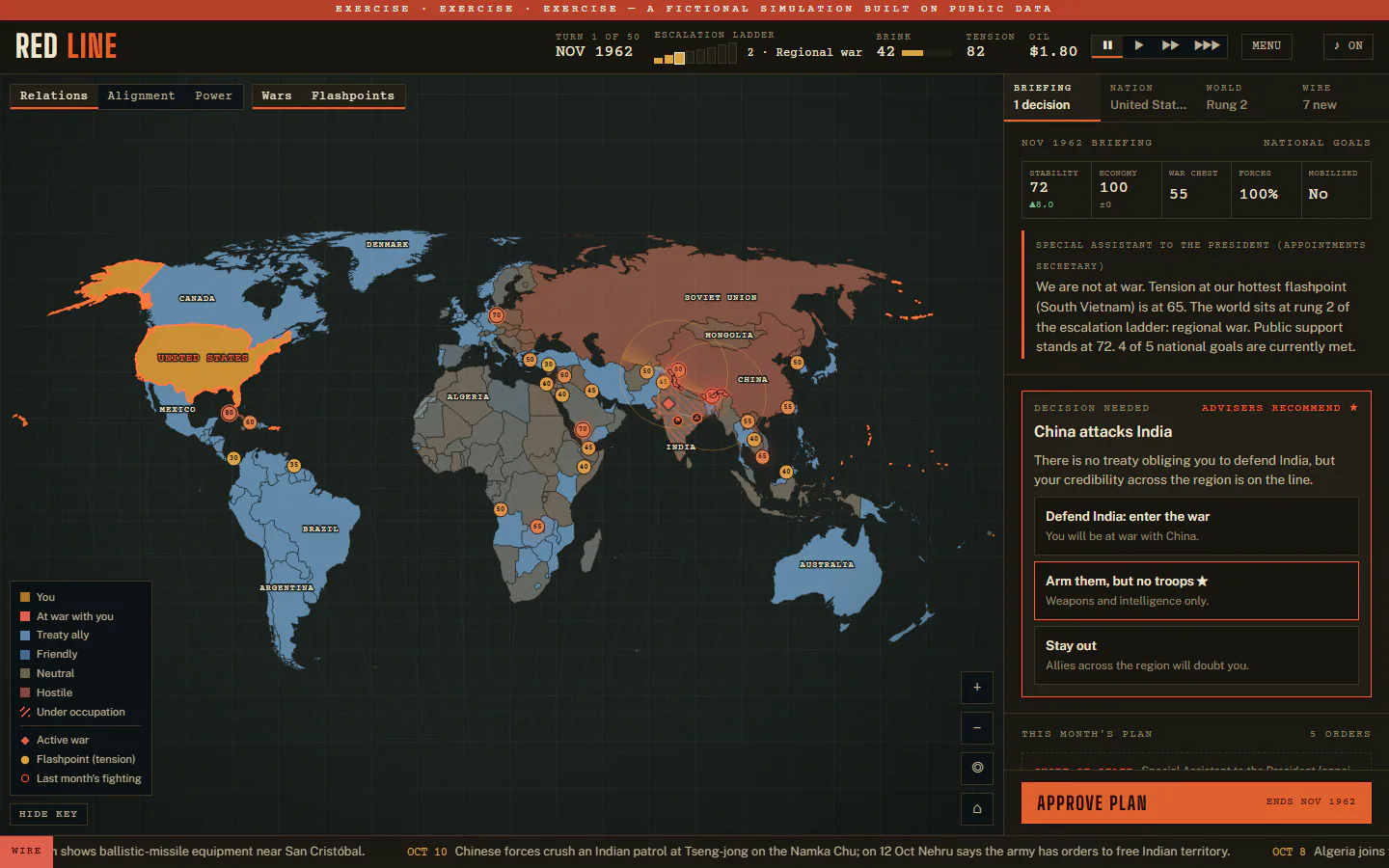
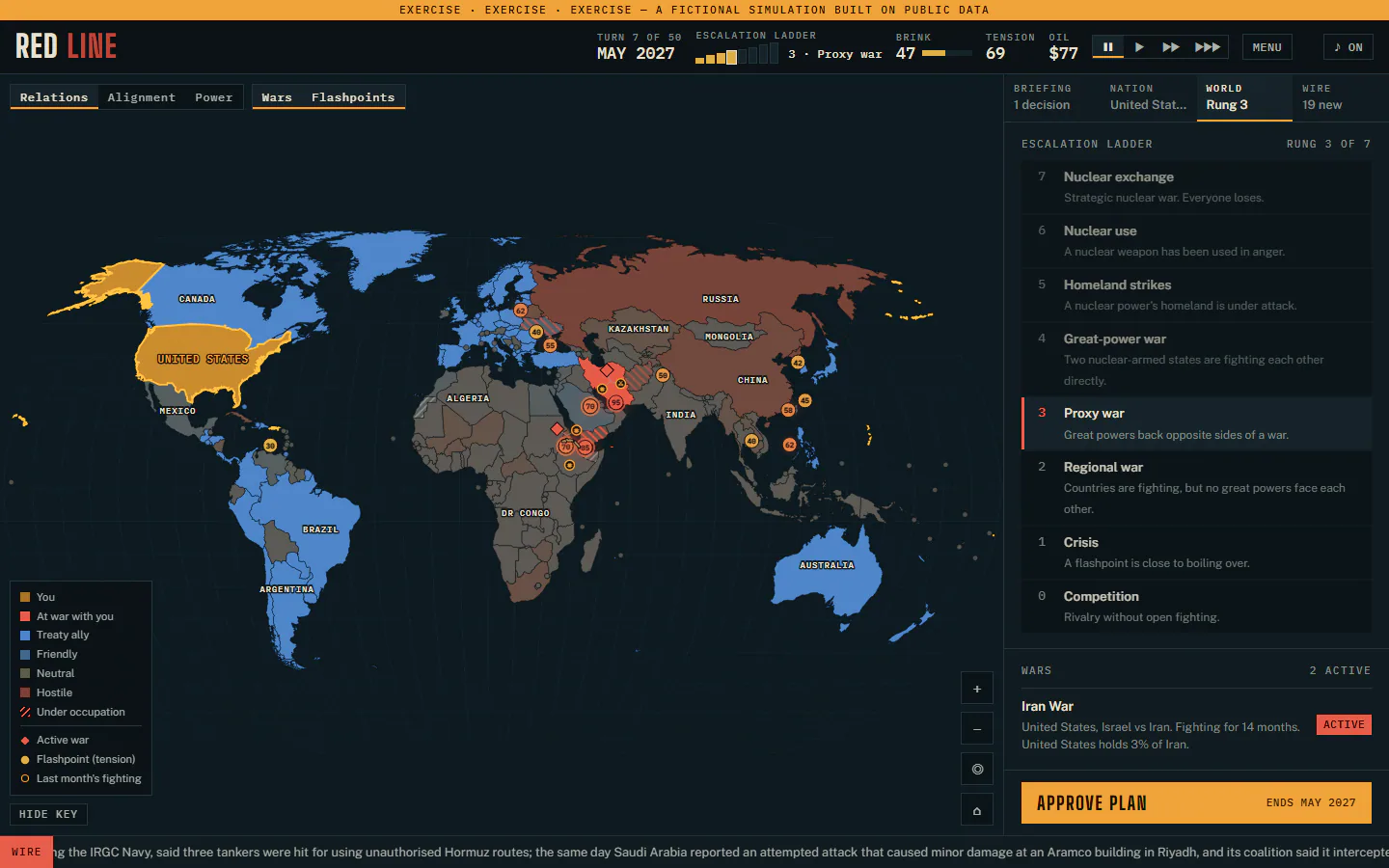
The world moves up and down an escalation ladder as wars start, spread and end, and a strategic nuclear exchange ends the campaign with everyone losing. When a nuclear weapon is used, the game estimates the dead, as a low-to-high range, with a simple model; the estimate is a record only and does not change play.
Facts
| Countries | Up to 197 |
|---|---|
| Turn | A month; in a crisis a week, a day, or an hour or less, by scenario |
| Escalation ladder | 8 rungs, from peace or competition to nuclear exchange |
| Present-day data | Researched 31 October 2026; news to 12 November 2026 |
| Difficulty | Easy, Normal, Hard or Brutal |
| Players | 1 |
Screenshots
Select one to see it full size
How it plays
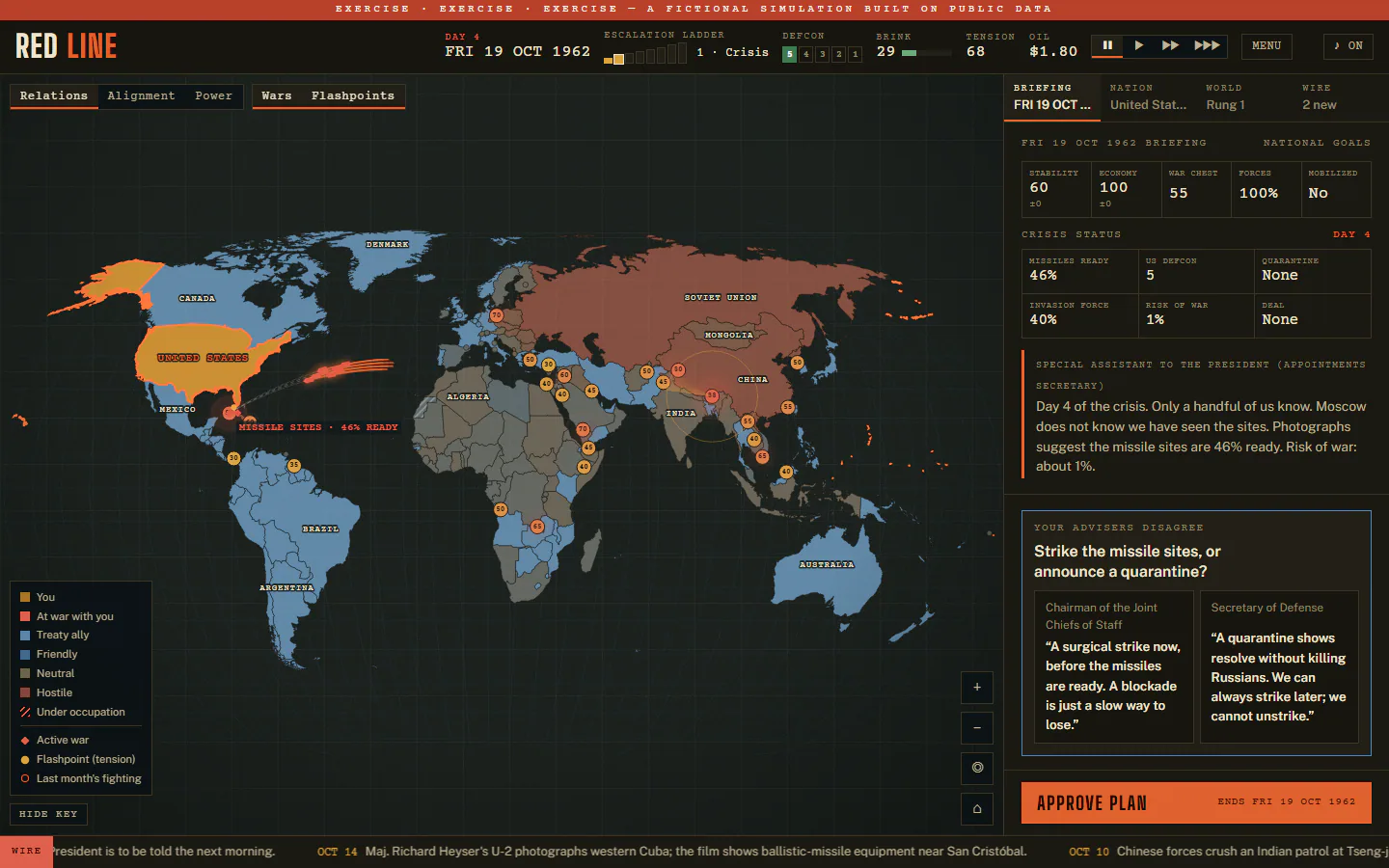
On the start screen, pick a scenario, then a country: click it on the map, search for it by name, or take one of the quick picks. Play as takes you to the Campaign tab, where you choose how you win, the game length, the difficulty and the options; Assume command starts the campaign. An opening window names your office and, when you play for national goals, lists them.
A turn
- Read the briefing
- Your chief of staff sums up the position, and each of the seven advisers, the chief of staff included, proposes an order or none.
- Change what you disagree with
- Use Change or Skip on an adviser’s card. Outside a crisis you can also click any country on the map for quick actions; during a crisis every order goes through your advisers.
- Answer the decisions
- Decision cards in the briefing offer a choice of answers, with ★ on the one your advisers recommend. A card still open when you approve the plan takes that recommendation.
- Approve plan
- Ends the turn. The world moves, and a report lists what happened in your country and around the world.
- ▶, ▶▶, ▶▶▶
- Let the advisers run the campaign at speed: about two seconds a turn, about 0.6 seconds, or as fast as it goes. ❚❚ pauses them, and they stop on their own when you are needed.
The campaign settings
- How you win
- National goals, the default: your country’s aims, listed in the opening window and under the Nation tab, and checked at the end. Survive & dominate: outscore every rival on power by the final turn (power combines economy, forces and stability, and counts occupied territory); the rivals are the whole world for the leading powers and your region, or part of it, for the rest. Diplomatic peace: end the wars on favorable terms without losing the confidence of your public. Sandbox: no victory screen.
- Game length
- Short, Standard, Long or Open: 20, 50 or 100 monthly turns, or no limit, not counting the crisis turns that come first. One Warhead Short always ends at turn 22, after the US election of November 1996.
- Options
- Fog of war (rival strength as your intelligence chief estimates it), home-front pressure (public opinion and elections can remove you from power), adviser debates, and the news wire. All four start switched on.
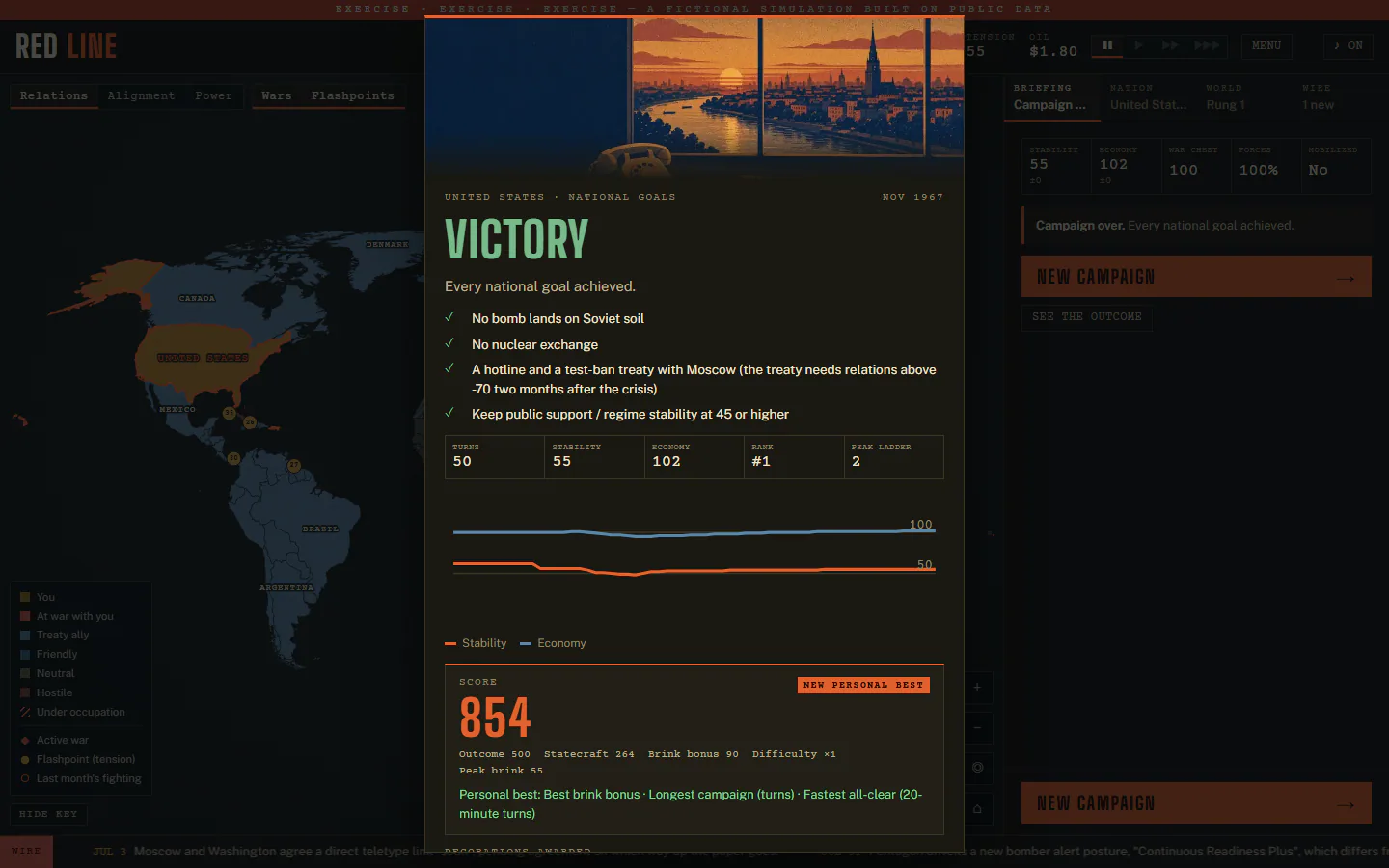
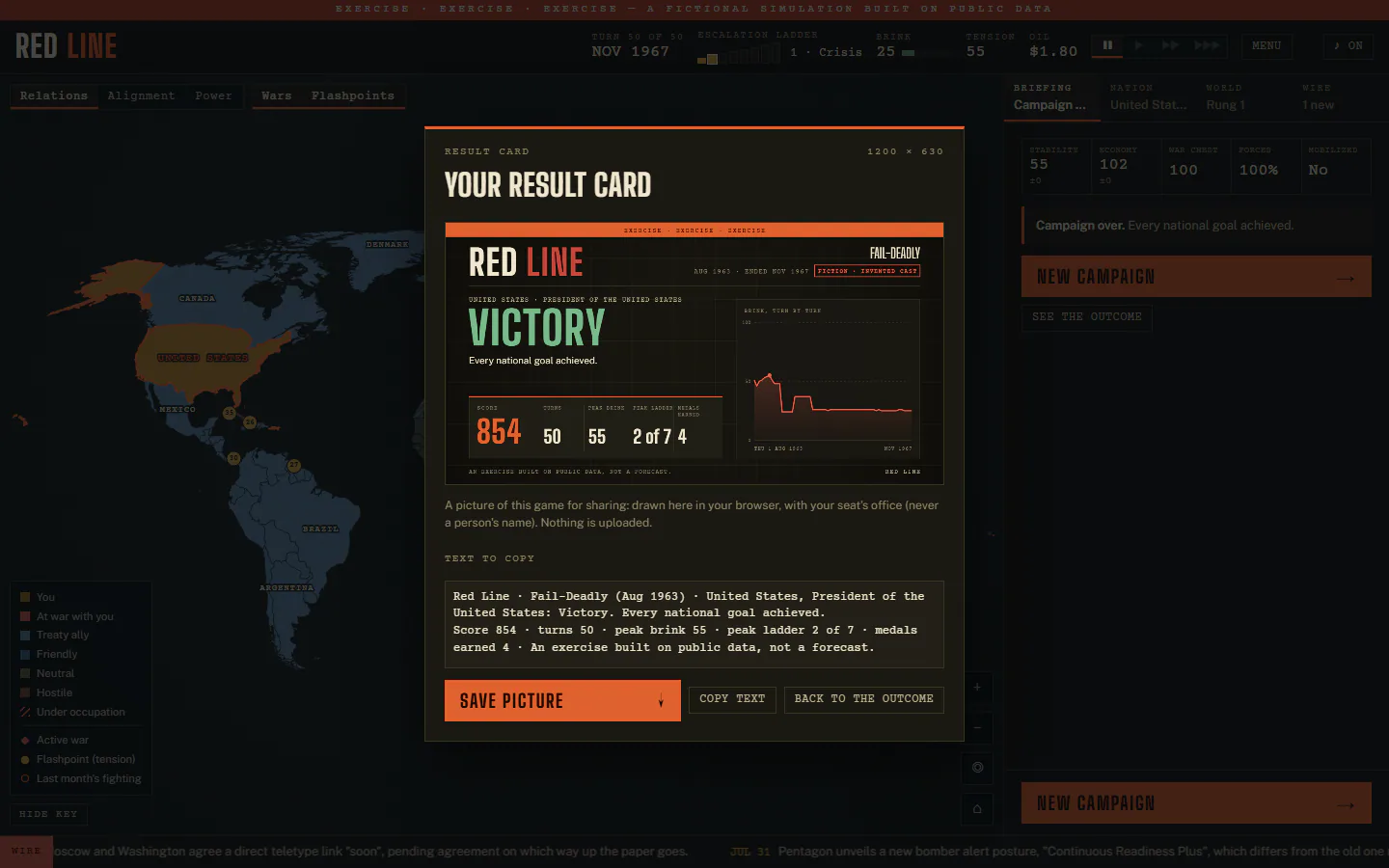
A campaign ends in Victory, Defeat, Nuclear war or Simulation complete. The outcome window gives the result and, when you play for national goals, how each one went. Campaigns you play yourself also get a score and any medals won, and go into the record book; watch mode and the simulation lab do not count. From the outcome you can open the result card or replay the campaign turn by turn.
The start screen also offers other ways to play: Watch the world, where every country is run by the computer; the Simulation lab, which plays a scenario many times in the background and shows the odds; and the Effects & sound lab.
Controls
| Run or pause the advisers | Space, in a campaign of your own, when no window is open and no button or field has focus. |
|---|---|
| Move and zoom the map | Drag to move it and use the mouse wheel to zoom; ⌂ goes back to the whole world. On a phone, two fingers move and zoom the map. |
| Close a window or the country card | Escape. It also stops the advisers’ run. |
| Sound on or off | M, or the ♪ button in the header. |
Notes
- The campaign is saved in this browser after every turn; the record book and the settings are kept there too. Clearing the site data for sims.games deletes all three. Menu → Download save writes the campaign and the record book to a file, and Load save file, on the start screen or in the Menu, reads it back in any browser.
- No AI model runs in the game. The other countries, and the present day’s opponent, are run by written rules and a seeded random draw.
- The present day’s world data were researched on 31 October 2026, and this copy carries the news to 12 November 2026, the dates its start screen shows.
- The present day’s world data were compiled from public sources by an AI research run, which also gathers the news from news reports. Before this copy went up, its headlines, its descriptions of wars, flashpoints and countries, and the officeholders’ names were checked against published reports and corrected; where the holder of an office could not be confirmed, the game shows the office without a name.
- Data sources and license texts are shown in the game under About & licences, on the start screen and in the Menu. The map shapes are from Natural Earth.
- The game labels Fail-Deadly and One Warhead Short Fiction. In the other scenarios, real officeholders are named on the advisers’ profile cards and in the news, for what they publicly did, and the advisers speak as their office.
- The ten illustrations, a title picture for each scenario and three for the end of a campaign, were generated with the Grok image tool.
Questions
Is Red Line free to play?
Yes. It is free and runs in the browser, with nothing to install, no account to make and no adverts.
Is Red Line a forecast?
No. It is a fictional simulation built on public data, and nothing in it is a forecast.
What do you control?
You lead one country, any of up to 197. Each turn your advisers propose a plan; you approve it or change it, and when two of them disagree, you choose between them. There are four difficulty levels: Easy, Normal, Hard and Brutal.
Which scenarios are included?
Seven. Four start from history: the Cuban Missile Crisis of October 1962; October 1973, when Egypt and Syria attack on Yom Kippur; 1979–80, with Soviet transports about to land in Kabul and Americans held hostage in Tehran; and autumn 1983, hours after a Soviet interceptor has shot down a Korean airliner. The present day is built from the real world and recent news. Two are satires with invented casts: Fail-Deadly, set in August 1963, and One Warhead Short, which opens in January 1995.
What is the escalation ladder?
A ladder of 8 rungs, from peace or competition to nuclear exchange. The world moves up and down it as wars start, spread and end, and a strategic nuclear exchange ends the campaign with everyone losing.
Where is a campaign saved?
In this browser, after every turn, with the record book and the settings. Clearing the site data for sims.games deletes them. Menu → Download save writes the campaign and the record book to a file, and Load save file reads it back in any browser.
What are the mature themes?
Nuclear war between real countries, with estimated death tolls, and present-day wars.